
Elastin, Wnt Signaling, and the Hair Growth Cycle: New Ex Vivo Evidence for a Novel Ingredient Blend
Elastin and hair growth are more closely linked than the cosmetics field has assumed. New ex vivo evidence from QIMA Life Sciences and NULASTIN Inc., recently published in the Journal of Cosmetic Dermatology (Piccini et al. 2026) shows that a novel ingredient blend can significantly increase elastin deposition inside the human hair follicle, prolong the anagen phase, and boost dermal papilla activity, all in the same experimental window.
Elastin has been overlooked in hair follicle biology. This article walks through why that is starting to change, how a novel ingredient blend performed against a cosmetic comparator in the ex vivo human hair follicle model, and what the findings on elastin deposition, anagen maintenance, and dermal papilla activity mean for cosmetic ingredient development and claim substantiation.
Share This Research Highlight
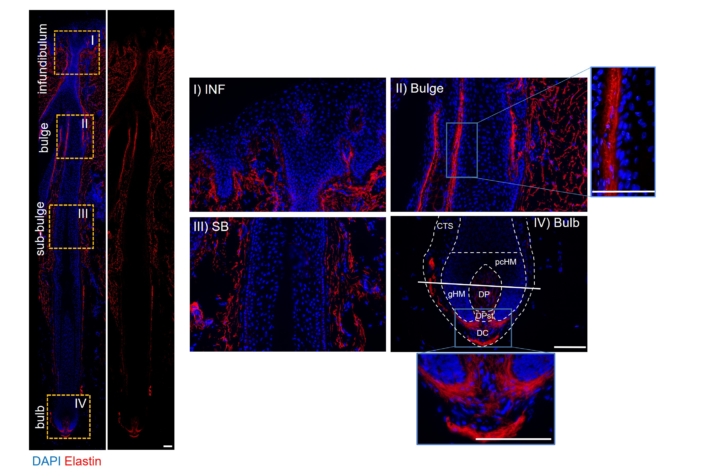
FIGURE 1: Elastin (red) forms a distinct network around the hair follicle bulge and dermal cup (Figure 1, Piccini et al., Journal of Cosmetic Dermatology, 2026).
Background: why elastin and hair growth deserve a second look
Elastin has been studied extensively in skin biology, but its role in the human hair follicle has received comparatively little attention. Decades-old histologic work first described elastin deposits, so-called elastin bodies, in the hair bulb, in the dermal papilla, and in the surrounding connective tissue sheath, with a pattern that shifts across the hair growth cycle. Despite this early evidence, the functional significance of elastin for follicle biology has remained largely unexplored.
Study objective: elastin, Wnt signaling, and the hair growth cycle
QIMA Life Sciences, together with NULASTIN Inc., investigated how a novel ingredient blend affects elastin expression and hair follicle function. The blend contains:
- Tropoelastin
- Palmitoyl hexapeptide-12
- Aronia melanocarpa fruit extract
- Momordica charantia fruit extract
- A fructooligosaccharide and beet root extract blend
- Hepatocyte growth factor (HGF)
Method: the ex vivo human hair follicle model
The blend was tested in the well-established, clinically predictive ex vivo human hair follicle model, using microdissected anagen VI follicles from healthy scalp donors. It was compared against isopropyl cloprostenate (IPC), a prostaglandin analog used in cosmetic eyelash-growth formulations.
Elastin expression was first mapped in freshly frozen, non-cultured scalp skin, then assessed after treatment alongside:
- Hair shaft elongation
- Hair cycle staging
- Hair matrix keratinocyte proliferation
- Dermal papilla (DP) inductivity markers (alkaline phosphatase activity, versican expression)
- Secretion of the Wnt/β-catenin inhibitor DKK1
Endpoints were quantified using immunofluorescence, quantitative histomorphometry, and ELISA.
Key findings on elastin, hair growth, and dermal papilla activity
Elastin expression. The blend significantly increased elastin deposition in the dermal cup and dermal papilla, and in the hair follicle bulge and infundibulum. IPC showed no elastogenic effect in any region tested.
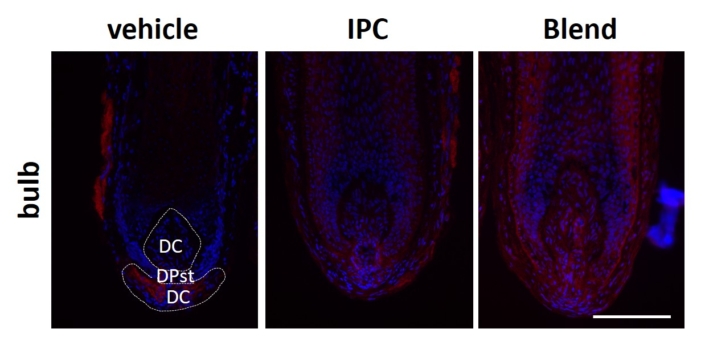
FIGURE 2: Representative elastin staining in the follicle bulb after treatment with vehicle, IPC, or the Blend (left to right). (Figure 2d (bulb), Piccini et al., Journal of Cosmetic Dermatology, 2026).
Tolerability. The blend was non-cytotoxic to the follicles and tended to reduce melanin clumping compared with vehicle control, a marker of follicle stress.
Anagen maintenance. The blend significantly prolonged the anagen (growth) phase, reflected in a significantly lower hair cycle score, and significantly increased hair matrix keratinocyte proliferation. These effects did not reach significance for IPC.
Hair shaft production. Both the blend and IPC showed a trend toward increased hair shaft elongation at the last day of culture.
Wnt-associated signaling. Both the blend and IPC modestly reduced secretion of the Wnt inhibitor DKK1 relative to vehicle control, a trend that did not reach statistical significance.
Dermal papilla inductivity. The blend significantly increased alkaline phosphatase activity in the DP, a validated inductivity marker, and showed a trend toward higher versican expression. IPC had no effect on either marker.
Why it matters for cosmetic ingredient development and hair growth claims
Taken together, these findings indicate that elastin plays a more significant, functionally relevant role in hair follicle biology than previously recognized, extending well beyond its established position in skin science.
This study is among the first to use immunostaining to functionally connect elastin deposition to hair follicle activity, reaffirming and extending histologic observations first reported decades ago. It also adds to a growing body of evidence for the suitability of the ex vivo human hair follicle organ culture model in resolving mechanism of action, not only functional outcome, for cosmetic ingredients. By distinguishing an elastogenic, DP-inductive candidate from a comparator with no such effects across the same multi-endpoint panel, the model demonstrates a level of mechanistic resolution relevant to its use as a predictive tool ahead of clinical study design.
As the authors note, clinical studies are needed to confirm hair growth efficacy of the blend under topical use conditions.
“Elastin has been overlooked in hair follicle biology for a long time. Seeing a single ingredient blend significantly increase elastin deposition alongside dermal papilla activity and anagen maintenance gives us a mechanistic thread that is well worth following into clinical research.”
Ilaria Piccini, PhD — Study Manager & Deputy CSO, QIMA Life Sciences, QIMA Monasterium GmbH
Discuss this research with our team
Frequently asked questions
What is the link between elastin and hair growth?
Elastin forms a distinct network around key hair follicle compartments, including the bulge, dermal papilla, and dermal cup. New ex vivo evidence shows that increasing elastin deposition in these compartments coincides with prolonged anagen and increased dermal papilla inductivity, suggesting elastin plays a functional role in hair follicle activity beyond structural support.
What is the ex vivo human hair follicle model?
It is a well-established, clinically predictive laboratory model that uses microdissected anagen VI hair follicles from healthy human scalp donors. Because the tissue is human and the follicles retain their native biology, the model is widely used to evaluate cosmetic ingredients before clinical trials.
Which ingredients were tested in this elastin and hair growth study?
The novel blend contained tropoelastin, palmitoyl hexapeptide-12, Aronia melanocarpa fruit extract, Momordica charantia fruit extract, a fructooligosaccharide and beet root extract blend, and hepatocyte growth factor (HGF). It was compared against isopropyl cloprostenate (IPC), a prostaglandin analog used in cosmetic eyelash-growth formulations.
What did the blend do that IPC did not?
The blend significantly increased elastin deposition across four follicle compartments, prolonged the anagen phase, increased hair matrix keratinocyte proliferation, and increased alkaline phosphatase activity in the dermal papilla. IPC did not produce significant effects on any of these endpoints.
Does this study prove the ingredient blend grows hair in humans?
No. The ex vivo data show significant effects on elastin deposition, anagen maintenance, and dermal papilla activity in a clinically predictive model. Clinical studies are needed to confirm hair growth efficacy of the blend under topical use conditions.
More resources
- Hair growth models and ex vivo assays — QIMA Life Sciences’ in vitro and ex vivo models for hair growth claim substantiation, including hair follicle organ culture and dermal papilla assays.
- Human hair follicle explant models — Details on QIMA Life Sciences’ microdissected hair follicle culture, readout parameters, and mechanism-of-action assays.
- Cosmetic efficacy testing and claim substantiation — Full range of in vitro, ex vivo, and clinical services for cosmetic ingredient and formulation testing.
Written & Edited by:
Sabrina Hoefling, PhD
Marketing Project Manager, Dermatology
August 07, 2026