We operate as a UK Home Office designated establishment under the Animals (Scientific Procedures) Act 1986 (ASPA). All regulated in vivo work is authorised under named project licences held by senior scientists, each of which requires a formal harm-benefit analysis reviewed and approved before any work begins. Every individual performing a regulated procedure holds a personal licence issued by the UK Home Office, awarded only following accredited training and demonstrated competency in the specific authorised techniques.
Our team currently includes over 15 trained personal licence holders on site, with regular in-house training sessions to maintain and expand competency across the technique portfolio. The full ASPA named persons structure is maintained, these roles provide a continuous welfare oversight layer that operates independently of individual study teams.
All proposed in vivo programmes are reviewed by our Animal Welfare and Ethical Review Body (AWERB) before study initiation, providing independent scrutiny of study design, harm-benefit balance, and welfare provisions.
The 3Rs framework — Replacement, Reduction, Refinement — is applied at study design stage, not as a post-hoc compliance review. In practice: in vitro and ex vivo work is used wherever scientifically valid ahead of in vivo escalation; group sizes are statistically powered to the minimum required to generate reproducible, valid results; humane endpoints are explicitly defined per protocol and applied proactively. All studies are documented and reported to ARRIVE guidelines.
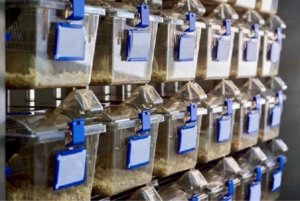
Animals are housed in a purpose-built SPF facility in individually ventilated cages (IVC), with species-appropriate social grouping, environmental enrichment, and clinical monitoring schedules specified per protocol. Animals are bred in-house, sourced from accredited UK and EU suppliers, or from specialist providers for non-standard strains. Genetically altered mice may be bred on site under a dedicated Home Office breeding protocol.