


Advances in neurocutaneous biology have expanded our understanding of skin function, giving rise to new approaches that address how the skin reacts, adapts, and is experienced. Sensations are no longer regarded as purely subjective phenomena, but as biologically grounded processes driven by complex, coordinated signaling pathways within the skin.
Within this context, neurocosmetics have emerged as a cosmetic approach aimed at modulating cutaneous perception, comfort, and reactivity through local neurocutaneous mechanisms. To date, sensitive and reactive skin constitute the most established neurocosmetic domains, while neurocosmetic principles are increasingly influencing the sensory design of skincare and perfumery products.
Discover our related blog articles
1. Skin: A Complex, Multifunctional Organ (More Than a Barrier)
1.1 The CINE system: How the skin orchestrates coordinated biological responses
The skin is now recognized as a complex, multifunctional organ integrating immune, neural, and endocrine components, collectively referred to as the cutaneous immuno-neuro-endocrine (CINE) system [1]. This system reflects the close and dynamic crosstalk between native skin cells, cutaneous sensory neurons, and resident immune cells.
Beyond their traditional roles, skin cells actively participate in immune and neuroendocrine signaling. Keratinocytes, melanocytes, fibroblasts, and immune cells can both produce and respond to a wide range of neuromediators, including neurotransmitters, neuropeptides, neurohormones, neurotrophins, and cytokines [2]. Through these mediators, the skin is able to sense external stimuli and orchestrate coordinated biological responses (Figure 1).
This intricate neuro-immuno-endocrine crosstalk is essential for maintaining cutaneous homeostasis, regulating barrier function, inflammation, and sensory perception. Disruption of the CINE system has been implicated in various skin disorders, highlighting its central role in skin physiology.
In cosmetic science, this concept has contributed to a shift in how skin function is understood, moving beyond a purely structural or biochemical view toward a more integrated, neurobiologically informed perspective.
1.2 The skin–brain axis: A bidirectional communication
Building on this local neuro-immuno-endocrine organization, the skin–brain axis describes the bidirectional communication network linking the skin and the nervous system. This concept emphasizes how cutaneous signals generated within the CINE system can be transmitted to the nervous system, and how neural and psychological factors can, in turn, modulate skin physiology [3].
Through this functional dialogue, emotional stress, environmental challenges, or sensory stimuli can influence cutaneous responses such as inflammation, sensitivity, or barrier alterations, while signals originating from the skin may affect psychophysiological states (Figure 1). The skin thus acts as an interface between the external environment and neural regulation, integrating peripheral perception with central responses.
From a developmental perspective, this close relationship is further supported by a shared embryological origin. Both the epidermis and the nervous system derive from the ectoderm, providing a common biological foundation that underlies their lifelong capacity for interaction [4].
Cutaneous disorders, including sensitive and reactive skin, are known to negatively impact quality of life [5, 6]. By alleviating cutaneous discomfort and improving skin tolerance, neurocosmetic interventions may therefore indirectly contribute to improved quality of life and perceived well-being, without implying any direct action on psychological functions.
2. Neurocutaneous Biology: The Scientific Foundation Behind Neurocosmetics
2.1. Moving beyond “classical” biology to understand all skin functions
For a long time, skin biology was primarily approached through structural and biochemical parameters, such as barrier integrity, lipid composition, inflammation, or cellular turnover. While these aspects remain essential, they are no longer sufficient to fully explain skin behavior, particularly in conditions characterized by sensitivity, reactivity, or stress-related responses.
Advances in neurocutaneous biology have introduced a broader understanding of skin function, integrating perception, signal integration, and adaptive responses. Sensations such as discomfort, stinging, tightness, or soothing are no longer viewed as purely subjective phenomena, but as biologically grounded processes resulting from coordinated neuro-immuno-endocrine signaling within the skin [7].
This shift has profoundly influenced cosmetic science. By acknowledging that skin responses are dynamic, context-dependent, and modulated by neurobiological pathways, cosmetic research has moved beyond a purely structural vision of efficacy. Skin function is now understood as the result of both biological activity and sensory perception, opening the door to new approaches that address how the skin reacts, adapts, and is experienced.
2.2. Neurocosmetics in practice: A working definition and scope
In this context, neurocosmetics has emerged as a cosmetic approach grounded in neurocutaneous biology. It refers to cosmetic products or ingredients designed to act on the skin by modulating the functioning of the neuro-immuno-cutaneous system at the epidermal level. The term has been used since the 1990s and was originally defined to describe cosmetic approaches targeting interactions between cutaneous nerves, skin cells, and immune mediators, without effects beyond the skin itself [3, 8].
Unlike conventional cosmetics, which primarily focus on visible skin attributes, neurocosmetics is based on the recognition of the skin as a sensory and neurobiologically active organ, closely connected to the nervous system. Within the regulatory framework of cosmetics, neurocosmetic products are intended to influence cutaneous perception, comfort, and reactivity through local neurocutaneous mechanisms, without acting on the central nervous system.
This definition applies to both skincare and perfumery, where formulations are conceived to go beyond appearance-driven performance by integrating sensory and perceptual dimensions, while remaining strictly within the cosmetic domain.
By considering skin responses as dynamic and context-dependent, neurocosmetics naturally supports a more integrative and personalized approach to product development, reflecting the interdisciplinary nature of this field and taking into account interindividual variability in cutaneous sensitivity, perception, and tolerance.
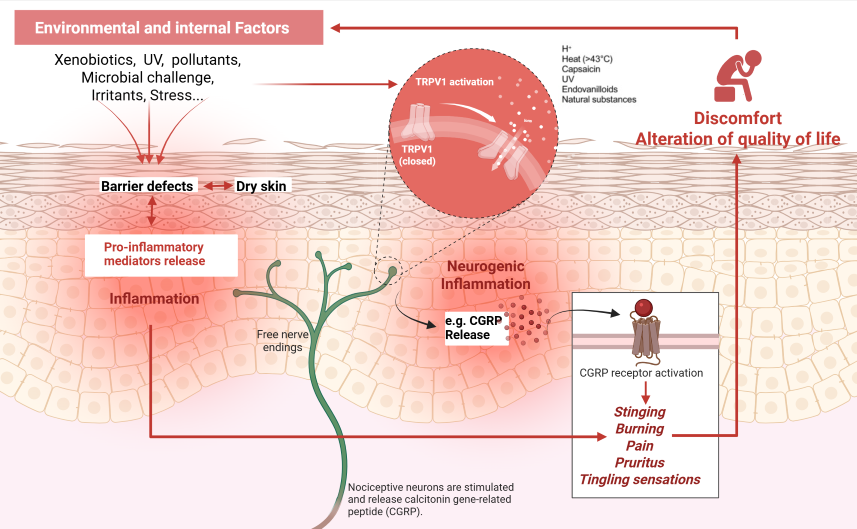
Figure 1.
Schematic representation of neuro-immuno-endocrine mechanisms involved in sensory discomfort in sensitive or reactive skin.
Environmental and internal stressors may induce barrier alterations and activate cutaneous sensory pathways, notably through TRPV1-expressing nerve endings. This activation promotes the local release of neuropeptides (e.g. CGRP), pro-inflammatory mediators, and neuro-endocrine signals produced by skin cells, contributing to neurogenic inflammation and sensory symptoms such as stinging, burning, pruritus, or tingling. These cutaneous sensory disturbances are known to negatively impact quality of life.
Neurocosmetic approaches aim to modulate these peripheral neuro-immuno-endocrine cutaneous mechanisms by limiting neurogenic inflammation, reducing neuropeptide release, and inhibiting or desensitizing TRPV1 activity, thereby improving skin tolerance and sensory comfort, without acting on the central nervous system.
Figure created with Biorender.com
3. Substantiating Neurocosmetic Claims: How The Cosmetic Industry Builds Evidence
3.1. Assessing neurocosmetic effects: Neurocutaneous and biological approaches
The substantiation of neurocosmetic claims relies on demonstrating effects mediated by local neuro-immuno-cutaneous mechanisms, in accordance with the scientific definition proposed by Misery and colleagues [8]. Preclinical evaluation strategies primarily focus on pathways involved in neurogenic inflammation, sensory transduction, and cutaneous reactivity, without systemic or central nervous system involvement [2].
In vitro approaches are commonly used to investigate interactions between keratinocytes, immune cells, and sensory neuron–related pathways. These models enable the assessment of key mediators such as substance P, CGRP, inflammatory cytokines, and the modulation of sensory receptors, including TRPV1 (Figure 1), which plays a central role in stinging, burning, and discomfort sensations [9–11]. Recent advances using human iPSC-derived sensory neurons have further strengthened the biological relevance of these targets by confirming functional TRPV1 signaling in human neuronal models, supporting their use in neurocutaneous research [12]. Beyond their mechanistic relevance, these models also address the limitations associated with animal-derived systems, which were previously used as alternatives to the challenging isolation of primary human dorsal root ganglia (DRG) neurons.
Ex vivo human skin explants are increasingly employed to preserve tissue architecture and neuro-immuno-cutaneous crosstalk, enabling the evaluation of ingredient or formulation effects on skin reactivity and inflammatory responses [13]. At the clinical level, biological substantiation typically combines provocation models (e.g. stinging or capsaicin tests) with non-invasive measurements such as erythema, microcirculation, or barrier function [14].
Together, these approaches provide mechanistic and functional evidence that neurocosmetic effects are mediated locally at the skin level.
3.2. Measuring what people feel: Tools for sensory and perceptual assessment
Sensory evaluation is a central component of neurocosmetic claim substantiation, as cutaneous sensations represent key outcomes of interest. Sensations such as stinging, burning, tightness, soothing, or comfort have long been used in cosmetic testing, particularly for sensitive skin, but are now interpreted through the lens of neurocutaneous biology rather than as purely subjective responses [14].
Standardized self-assessment questionnaires and visual analogue scales are used under controlled conditions to document perceived comfort, relief, or tolerance over time. These tools are often applied in conjunction with exposure or challenge protocols to enhance sensitivity and reproducibility. Increasingly, subjective sensory data are complemented by objective skin measurements (such as redness, hydration, or barrier recovery) that correlate with changes in sensory perception.
In perfumery and sensorial formulation, trained sensory panels and consumer studies are used to characterize tactile and olfactory perception. Importantly, these methodologies aim to link sensory experience to peripheral sensory processing, reinforcing claim credibility while avoiding any implication of direct psychological or neurological action.
4. Key Applications of Neurocosmetics
4.1. Sensitive and reactive skin: the most established neurocosmetic domain
Sensitive and reactive skin is characterized by unpleasant sensations including, burning, stinging, itching, tightness, often disproportionate to visible signs (Figure 1) [15]. Scientific evidence links these symptoms to neurosensory hyperreactivity and neurogenic inflammation, involving altered activation of sensory nerve endings and increased release of neuropeptides [16].
Neurocosmetic strategies for sensitive skin aim to restore neurocutaneous homeostasis by modulating sensory receptors and inflammatory mediators, thereby improving skin tolerance and reducing discomfort. Clinically, this translates into improved comfort and reduced reactivity to environmental or cosmetic stressors.
Because sensitive skin and related disorders are known to negatively impact quality of life, improvements in cutaneous comfort may indirectly contribute to better perceived well-being [17]. This effect is understood as a consequence of local skin improvement and remains fully consistent with the cosmetic regulatory framework.
4.2. Neurocosmetics and sensory design: skincare textures and perfumery experiences
Beyond specific skin conditions, neurocosmetics have influenced the sensory design of skincare and perfumery products. Texture, spreadability, thermal sensation, and olfactory cues are increasingly engineered to interact with peripheral sensory pathways and enhance cutaneous comfort during product use [18].
In skincare, sensory optimization can help minimize discomfort and improve immediate acceptance, particularly for fragile or stressed skin. In perfumery, although fragrances are not neurocosmetics per se, olfactory perception is closely linked to skin–brain communication through well-characterized sensory and neurophysiological pathways [18]. Scientific substantiation in this context relies on sensory analysis and consumer studies, clearly distinguishing peripheral sensory modulation from any central emotional or psychological claims.
5. Take-Home Messages
Neurocosmetics is firmly grounded in advances in neuro-immuno-endocrine cutaneous biology, which recognize the skin as a complex sensory, regulatory, and responsive organ. By integrating biological, functional, and sensory assessment strategies that account for neurocutaneous, immune, and endocrine signaling at the local level, the cosmetic industry can substantiate claims related to comfort, tolerance, and perception in a scientifically robust and regulatory-compliant manner.
Applications such as sensitive skin management and sensory-driven formulation illustrate how neurocosmetics enhances cosmetic efficacy without extending beyond the boundaries of cosmetic action. This integrative approach supports more precise, responsible, and biologically informed innovation, reinforcing the importance of rigorous evaluation and expert validation in an evolving field increasingly shaped by interdisciplinary skin science.
Written by:
Rachida Nachat-Kappes, PhD
Skin Biology Expert
Edited by:
Mara Carloni, PhD
Scientific Communications & Marketing Project Leader
Last update: 05/02/2026
Eager to bring your skincare innovations to life?
References
- Shastri M, Sharma M, Sharma K, Sharma A, Minz RW, Dogra S, and Chhabra S. Cutaneous-immuno-neuro-endocrine (CINE) system: A complex enterprise transforming skin into a super organ. Exp Dermatol. 2024.
- Marek-Jozefowicz L, Nedoszytko B, Grochocka M, Żmijewski MA, Czajkowski R, Cubała WJ, and Slominski AT. Molecular Mechanisms of Neurogenic Inflammation of the Skin. Int J Mol Sci. 2023.
- Haykal D, Berardesca E, Kabashima K, and Dréno B. Beyond beauty: Neurocosmetics, the skin-brain axis, and the future of emotionally intelligent skincare. Clinics in Dermatology. 2025.
- Jameson C, Boulton KA, Silove N, Nanan R, and Guastella AJ. Ectodermal origins of the skin-brain axis: a novel model for the developing brain, inflammation, and neurodevelopmental conditions. Mol Psychiatry. 2023.
- Misery L, Jourdan E, Huet F, Brenaut E, Cadars B, Virassamynaïk S, Sayag M, and Taieb C. Sensitive skin in France: a study on prevalence, relationship with age and skin type and impact on quality of life. JEADV. 2018.
- Park M, Park S, and Jung WH. Skin Commensal Fungus Malassezia and Its Lipases. JMB. 2021.
- Chen B, Tang H, Liu Z, Qiao K, Chen X, Liu S, Pan N, Chen T, Liu Z, Chen B, et al. Mechanisms of Sensitive Skin and the Soothing Effects of Active Compounds: A Review. Cosmetics. 2024.
- Misery L, Maibach HI, Koo J, and Jafferany M. Neurocosmetics are cosmetics, which mean that they could have effects only on skin. Clin Dermatol. 2025.
- Shah R, Kaul N, Tan I, and Rossi A. Clinical Utility of TRPV1 Modulation for Skincare Sensitivity. J Drugs Dermatol. 2025.
- Xiao T, Sun M, Zhao C, and Kang J. TRPV1: A promising therapeutic target for skin aging and inflammatory skin diseases. Front Pharmacol. 2023.
- Kueper T, Krohn M, Haustedt LO, Hatt H, Schmaus G, and Vielhaber G. Inhibition of TRPV1 for the treatment of sensitive skin. Exp Dermatol. 2010.
- Tay SH, Pang JKS, Ng W, Ng CY, Khong ZJ, Chong Z-S, Soh BS, and Ng S-Y. iPSC-derived human sensory neurons reveal a subset of TRPV1 antagonists as anti-pruritic compounds. Sci Rep. 2024.
- Vidal Yucha SE, Tamamoto KA, and Kaplan DL. The importance of the neuro-immuno-cutaneous system on human skin equivalent design. Cell Prolif. 2019.
- Li Q, Xu Y, Shu H, Li N, Gu H, He L, and Tu Y. Lactic acid sting test and capsaicin test differentially induce facial erythematous reaction in subjects with sensitive skin. JCD. 2024.
- Misery L, Ständer S, Szepietowski JC, Reich A, Wallengren J, Evers AWM, Takamori K, Brenaut E, Le Gall-Ianotto C, Fluhr J, et al. Definition of Sensitive Skin: An Expert Position Paper from the Special Interest Group on Sensitive Skin of the International Forum for the Study of Itch. Acta Derm Venereol. 2017.
- Kim H, Kim S, Nho Y, Chung E, Kim S, and Kang S. TRPV1-overexpressing keratinocytes reveal sensory mechanisms and barrier disruption in sensitive skin. J Invest Dermatol. 2025.
- Falcao L, Nachat-Kappes R, Filaire E, Falcao L, Nachat-Kappes R, and Filaire E. In and out Beauty and Sensitive Skin, a Psychophysiological Exploration: Myth or Reality? Cosmetics. 2024.
- Kandhasamy S and Songmun K. Influence of Fragrances on Human Psychophysiological Activity: With Special Reference to Human Electroencephalographic Response. Sci. Pharm. 2016.
- Sánchez-Peña MJ, Magallón-Chávez O, Rivas-Loaiza JA, Sánchez-Peña MJ, Magallón-Chávez O, and Rivas-Loaiza JA. Neurocosmetics and Aromatherapy Through Neurocutaneous Receptors and Their Functional Implications in Cosmetics. Cosmetics. 2025.