Bioanalysis Services
Analytical Chemistry &

End-to-end analytical chemistry solutions that combine technical excellence, regulatory expertise, and scientific insight.

Analytical Chemistry and Bioanalysis Services

QIMA Life Sciences provides analytical chemistry and bioanalysis services that combine technical depth, regulatory‑aligned workflows, and scientific insight across development stages. Delivered through specialist laboratories within the QIMA Life Sciences network, our capabilities support formulation development, stability assessment, impurity and degradation control, and exposure‑related analytical studies.

Our focus is on generating reliable, decision‑ready analytical data to support product safety, quality, and regulatory compliance across pharmaceutical, cosmetic, nutraceutical, veterinary, and medical device sectors.
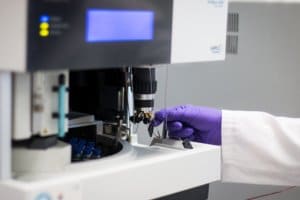
Our Analytical Chemistry Capabilities at a Glance

Markets Served

  • Pharmaceuticals
  • Cosmetics
  • Veterinary Medicine
  • Medical Cannabis
  • Medical Devices
  • Chemicals

Study types and core services

  • Routine analytical testing & QC
  • Method development & validation
  • Stability & shelf‑life studies
  • Advanced characterisation
  • Forced degradation studies
  • Bioanalysis & PK/PD support
  • Compatibility & thermal studies
  • Impurity, degradation & chemical risk
  • Dissolution & release studies
  • Residual solvents & nitrosamines
  • Elemental & metallic impurities
  • Extractables & leachables

Quality & Compliance

GLP‑aligned laboratory operations: REBLAS‑ and ANVISA‑authorised with robust data integrity systems.

Validated analytical systems: Qualified, calibrated instruments.

Global regulatory readiness: Aligned with ICH, USP, EMA, and FDA.

Samples & Matrices

Pharmaceutical & cosmetic formulations in various states.

Biological matrices: Blood & biofluid samples, tissues, and non‑invasive, biopsy or reconstructed skin models.

Natural extracts, active ingredients, and raw materials

Foundations of our Analytical Chemistry Services

Our analytical chemistry services follow the same principles as QIMA Life Sciences’ integrated research solutions, bringing together specialist analytical laboratories and centres of excellence in a global, comprehensive service model. Our approach is centred on close scientific collaboration, clear communication, and analytical work delivered in context, with clients benefiting from our long‑standing commitments to quality, efficiency and added value.

Specialist depth, network scale

Our services are delivered by specialist laboratories with deep technical expertise in defined areas, from formulation studies to natural‑derived materials. By coordinating this depth within an integrated service model, clients can access the right expertise at the right stage, with data continuity and seamless connection to preclinical and clinical services.

Quality- & decision-driven data

Our analytical studies are conducted within established quality and regulatory frameworks and designed to support development decisions. This ensures methods, data, and reporting are compliant while remaining directly relevant to study objectives, development strategy, risk assessment, and downstream regulatory requirements.

Collaborative project management

Projects are managed through close collaboration with our clients, and within multidisciplinary and highly qualified science teams. This approach brings adaptability to project needs, keen awareness of timelines and priorities, and added value through technical and regulatory consulting and ongoing scientific support.

Analytical Chemistry Studies and Core Services

Our analytical chemistry services cover a broad range of study types and service offerings with different objectives. Each tab below reflects the scope of analytical chemistry solutions delivered across the QIMA Life Sciences network, outlining what each service or study involves, how it is typically applied, and our alignment with relevant regulatory contexts. While ANVISA requirements are most often cited due to the location of our analytical labs, note that our studies fully meet even the strictest international regulations and criteria for analytical methods.

Analytical Instrumentation and Technology

Our analytical chemistry services are delivered using a comprehensive and tightly controlled technology stack operated within GLP‑compliant laboratory environments, including REBLAS‑accredited facilities. Instrumentation is routinely qualified, calibrated, and performance‑verified, supported by full proficiency testing and certification (e.g. Controllab) to ensure analytical reliability.

These systems operate under robust data integrity, control, and traceability frameworks, meeting expectations for regulated use across ANVISA, FDA, EMA, ICH, and USP contexts. This ensures analytical data generated across the QIMA Life Sciences network are consistent, defensible, and suitable for development, submission, and audit.

Chromatographic separation equipment

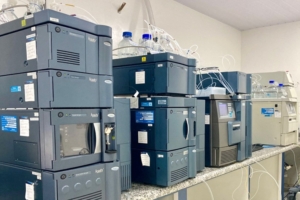
  • 40+ liquid chromatography (LC) systems, primarily ultra‑high‑performance liquid chromatography (UHPLC).
  • LC systems configured with mass spectrometry (MS), diode array detection (DAD), fluorescence detection (FL), and refractive index detection (RID).
  • Gas chromatography with flame ionisation detection (GC‑FID) and gas chromatography–mass spectrometry (GC‑MS) systems dedicated to residual solvents, extractables and leachables, and medical device characterisation.
  • High‑throughput and high‑resolution configurations supporting quality control, stability, dissolution, and impurity studies.

Mass spectrometry and trace detection

  • UHPLC‑coupled triple quadrupole mass spectrometry (QqQ‑MS) for high‑accuracy quantification.
  • 22 liquid chromatography–tandem mass spectrometry (LC‑MS/MS) Q‑Trap systems supporting routine and trace‑level analysis.
  • 3 UHPLC high‑resolution mass spectrometry (HRMS) Orbitrap‑class systems for accurate‑mass identification.
  • 3 liquid chromatography–mass spectrometry quadrupole time‑of‑flight (LC‑MS Q‑TOF) systems for full‑scan and unknown elucidation.
  • Trace‑level workflows supporting nitrosamines, impurities, extractables and leachables, and bioanalysis.

Spectroscopy and structural characterisation

  • Nuclear magnetic resonance (NMR) spectroscopy.
  • Fourier‑transform infrared (FTIR) spectroscopy, including attenuated total reflectance (ATR‑FTIR).
  • Ultraviolet–visible (UV‑Vis) spectrophotometry.
  • X‑ray diffraction (XRD).
  • Atomic absorption spectroscopy (AAS).
  • Structural confirmation, solid‑state analysis, and deformulation support.

Thermal and physicochemical analysis

  • Differential scanning calorimetry (DSC).
  • Thermogravimetric analysis (TGA).
  • Melting behaviour and phase transition analysis.
  • Moisture determination (e.g. Karl Fischer titration).
  • Lipid stability metrics including iodine value (IV).
  • Support for compatibility, stability, excipient, and packaging studies.

Elemental, ion, and specialised analysis

  • Inductively coupled plasma–mass spectrometry (ICP‑MS) with microwave digestion for elemental impurities.
  • Inductively coupled plasma–optical emission spectrometry (ICP‑OES) for multi‑element analysis.
  • Ion chromatography (IC) systems for anion and cation analysis.

Frequently Asked Questions (FAQS)

Analytical chemistry is most effective when engaged early, although the timing may vary depending on budget, pipeline maturity, and development strategy. Early involvement helps establish a robust chemical foundation, for example understanding solubility, formulation behaviour, and composition. This in turn makes downstream medicinal and biological investigations more interpretable. Continued engagement across development supports consistency, comparability, and regulatory readiness as products progress toward clinical and commercial stages.

Yes. Analytical studies are designed to be adaptable to different regional regulatory expectations and submission contexts and are aligned with international standards. Rather than following a single jurisdictional framework, methods and data packages are structured to support use across multiple regulatory environments, and follow the most stringent guidelines possible.

Analytical studies are designed using internationally recognised frameworks and adapted to the specific regulatory and product context rather than following a single jurisdictional template. For example, in medical device development, analytical chemistry supports chemical characterisation and safety evaluation through studies aligned with ISO 10993‑18, including stress studies, device material characterisation, and calculation of the Analytical Evaluation Threshold (AET). These workflows may involve techniques such as headspace GC‑FID/MS, GC‑FID/MS, UHPLC‑PDA, high‑resolution UHPLC‑MS/MS, and ICP‑MS/OES, supported by compound libraries for tentative identification of extractables.

The same principles—risk‑based study design, regulatory alignment, and analytical justification—are applied across pharmaceuticals, cosmetics, and other regulated products, allowing analytical strategies to be scaled and adapted as programmes move between regions, indications, and development stages.

Analytical work is performed within controlled laboratory environments using qualified and calibrated instrumentation, with defined procedures for data handling, traceability, and review. This ensures that analytical data are reproducible and suitable for audit or regulatory inspection.

When analytical datasets don’t provide clear conclusions, additional investigative and orthogonal approaches are often applied to clarify  causes and the underlying chemical reality. This may include advanced characterisation, alternative sample preparation strategies or analytical methods, and targeted stress or compatibility studies. These activities are carried out in close collaboration with client teams to iteratively refine the analytical approach and ensure the resulting data can be acted upon and studies continue to fit the scope of the development programme.

Discuss your Analytical Strategy with our Scientists

Analytical chemistry is an essential part of developing and delivering marketable products, underpinning decisions from formulation refinement and impurity control to stability, safety, and regulatory readiness. QIMA Life Sciences provides an integrated portfolio of analytical chemistry, advanced characterisation, and bioanalytical capabilities as a core component of our global services, supporting pharmaceutical, cosmetic, nutraceutical, veterinary, and medical device development across a wide range of indications and R&D programmes.

Our approach supports routine testing, formulation optimisation, risk and safety assessment, and bioanalysis across preclinical, clinical and post-market contexts. Whether you’re establishing an analytical strategy, refining a formulation, or preparing for regulatory submission, our scientists work closely with your team to generate reliable, defensible data.

This field is for validation purposes and should be left unchanged.

Hello! How can we help you?

It takes less than a minute to ask us your question.

We will get back to you shortly!

Name(Required)
Keep up with what's happening in QIMA Life Sciences?(Required)