
Discover our preclinical
oncology solutions
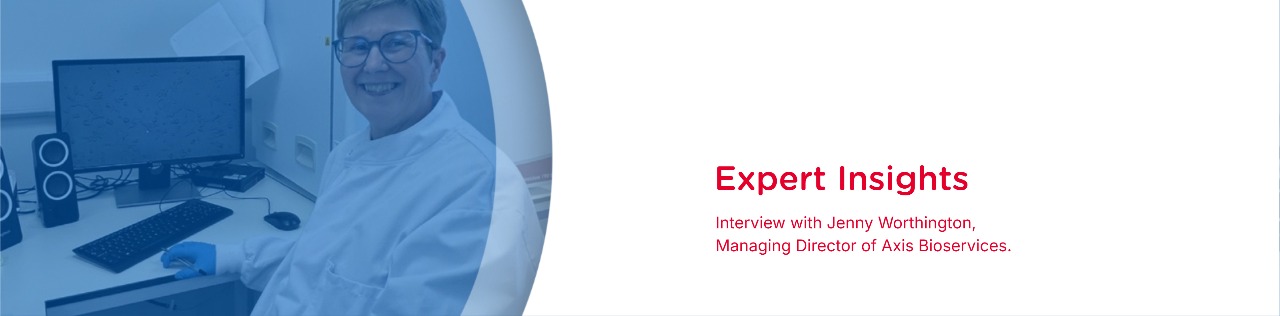
You co-founded Axis Bio 13 years ago. Could you paint a picture of those early days – first lab, project, and hurdles – and how your oncology work has evolved since then?
JW: When we started, there were literally four of us in a tiny lab with very basic equipment and a huge amount of enthusiasm. One of our first major projects came from a client who needed a study done quickly to support a funding milestone. We didn’t have the resources we do today, but we pulled together, delivered on time, and that set the tone for how Axis Bio operates.
The biggest hurdle back then was capacity. Every time we brought on a new tumour model we had to build and validate it from scratch, learning as we went. That worked quite well though because it meant the whole science team knew every detail of each model and could speak to clients with real confidence.
Today the picture is completely different. We have a full oncology platform and run much more complex studies. What hasn’t changed is our direct communication with clients and the scientific intimacy that began in that first small lab.
We often see headlines about breakthrough cancer therapies, yet few become routine treatments, and there hasn’t been a cure. Why is that?
JW: The simple answer is that cancer is very complex. It’s not one disease but hundreds, even within the same tumour type. A drug that looks promising in cell or animal models doesn’t always translate to humans. As therapies move through clinical phases, they tend to fall away as the questions become harder.
Early trials ask, “Does it work at all?” Later stages must show safety, benefit for the right patients, and work better than what we’ve already got. Many good ideas just don’t clear all these hurdles. The silver lining is that each failure still teaches us something more – about tumour biology, biomarkers, or study design – that improves future research. The key is that we just need to keep trying.
Oncology suffers some of the highest attrition rates in drug development. From a preclinical perspective, what challenges do programmes face?
JW: There are lots of really clever people with clever ideas when it comes to oncology treatments, but the first challenge is always the complexity of cancer. Given the intricacies of it, you nearly have to map out a development pathway from the very beginning, which is almost impossible. It’s no longer enough to show that a drug works; you must understand exactly how it works, what it interacts with, and whether it involves the immune system – which is a major question for all cancer therapies now.
Patient selection is another hurdle. When you design a pipeline, you nearly have to know what your patient selection will look like. Toxicity and therapeutic windows are age-old concerns. Although newer therapies are generally a lot better than traditional chemotherapies in this regard, toxicity still has to be managed at every stage. So it’s all about careful study design and building the right evidence pack as the programme advances.
What approaches can we take to address these pitfalls when designing early-stage oncology studies?
JW: The starting point is to ask the right biological questions. Get as much advice as you can and think about what models you’re going to test your therapies in.
Be aware that no single model is going to be enough; consider more complex models, multiple models, and what biomarkers you’ll look at. Even from this early stage you should be thinking about the clinic and answering mechanistic questions – pharmacokinetics, safety, cytokine profiling and so on.
It sounds like a huge challenge, and it is. But thinking about these things from an early stage, and approaching studies with flexibility and openness to advice will really help.
When a client brings you a new or first-in-class molecule, how do you guide them in choosing the ‘right models’ to reach key milestones?
JW: This brings us on to something I feel very strongly about. It used to be that contract research organisations were simply service providers, but this is a perfect scenario where you need to embrace that service provider as part of your team. You can’t just hand over a list of studies and have them run; trust us and use our experience. We’ve seen a lot of different studies, and we’ve seen a lot of things fail, so we can provide some really good guidance.
Our first step is to understand the biology. Once we do, we can recommend the most appropriate models and advise on what’s a “need-to-know” experiment versus the “nice-to-know” ones – because we don’t all have large-pharma budgets. So we work out what that package of data should look like, what the most useful studies are for that, and pick the best models to use. That’s all something that Axis Bio can help with.
Precision medicine, immuno-oncology, and antibody-drug conjugates are getting a lot of recent attention. Are there other trends in oncology that you think are flying under-the-radar?
JW: I think precision medicine and immuno-oncology have earned their attention; they’re transforming cancer treatment. But as always there are several other ideas coming to the fore. For example, targeting tumour metabolism. Cancer cells divide more rapidly, so things like lactate signalling, nutrient competition, and T-cell metabolic exhaustion are likely playing a bigger role than we think.
the tumour micro-environment beyond the immune cells. We’ve looked at T cells for quite a while now but elements like stroma, fibroblasts, vasculature and the extracellular matrix can be really important in dictating whether a drug succeeds or fails. So I think there’s potential in targeting these components.
Lastly, innate immunity could be a major growth area. There’s been a lot of time put into adaptive immune targets, but things like natural killer cells, macrophages, and pattern-recognition signalling are starting to show real promise and I think we’ll see a lot more of that because it’s more broadly applicable across patients.
Watch our Webinar Replay
Featuring Jenny:
Next-gen Oncology Models
There is growing push to reduce and refine the use of animals in research, and advanced non-animal models are gaining traction. With that in mind, how do you see preclinical oncology evolving over the next five to ten years?
JW: We are in a transition period. The field isn’t going to switch and suddenly stop using animal models, but will use them much more intelligently and selectively. There’s a growing push to refine animal models and rightly so, but we do need these complex immune systems, especially for oncology.
Programmes will increasingly begin with sophisticated in vitro systems – 3D organoids, co-cultures and micro-physiological platforms – to generate rich readouts early on. I don’t think these tests will entirely replace animal models for oncology, but they will allow smaller-scale and more relevant animal studies.
I think we’ll move away from large-scale xenograft models and towards smaller, bespoke challenges, and the trend towards AI will also help in many ways. I don’t see AI as something that’s going to take our business away from us – it’s part of a pathway and it’s going to give us a lot of information. Which will still need wet-lab testing and confirmation in living systems.
Scientifically, it’s an exciting time to be in preclinical research. We’ll be developing much more complex and purposeful models, and bringing them to market.
Looking ahead, what excites you most about Axis Bio’s role in the oncology landscape over the next decade?
JW: I’m excited because we occupy a unique position. We’re now large enough to handle complex oncology programmes, yet small and agile enough to pivot quickly as new scientific or client needs arise. In the coming years I expect us to move beyond simply running studies; we’ll become a part of our clients’ study teams, and help them design smarter, more agile studies which use fewer animals but really make them count.
As I’ve said, we’re in a transitional era, and we’re not standing still. We’re constantly working on new models, including humanised systems, to help push our clients forward. What will never change is our focus on “need-to-know” data versus “nice-to-know” data, and that when you come to us, we will put our team behind you. Whether you’re a startup or a big-pharma company, we bring all our experience to guide choices, advise on what’s important to know and what’s needed for your programme. It’s all about streamlining research, staying nimble, and staying with the science to push those oncology programmes forward.